The Merit of MentorshipA Note From Bill Mentoring is an important part of the architecture ecosystem. Ask any of us, and you’ll hear about how formative those early years in the field were, when you had guidance from those with decades more experience than you. Architecture school only teaches you so much; some design basics, technical terminology, and structural know-how—all important stuff, mind you—but mentorship teaches you how to apply that knowledge into real practice, with real people. Throughout the years, I have always loved to mentor the younger generation of architects who have passed through the Studio21 Architects doors. Resident architect, Gregg, started his career at the firm as an intern and, after graduation, came on to work with us full time. Now, he is a fundamental part of this company. We also have Beck, currently our drafter, getting mentorship through Gregg and myself as he prepares for his licensing exams. He also joined the team as a part-timer while finishing his Masters, and now he is a full-time part of the firm, and the man behind all of the fantastic renderings you see.
young architect. Letting them try some design ideas and then critiquing the various options in a manner that explains why one solution is better than the others, or maybe a combination of solutions, and discarding the one that sucks for various reasons. Mistakes are a valuable learning opportunity, especially as a mentor, when you can explain the reasons why.
Until Next Time...Bill StyczynskiBill Styczynski is the president of Studio21 Architects, as well as an architect in his own right. Every month, Bill writes an article for the Studio Pages newsletter about design topics that he believes will be informative, helpful reads for all of our clients, established and potential.
0 Comments
New Valve, New House, New Me!A Note From BillI have shared the details of my forever home journey with you all for over a year now, and I am beyond happy to report that we have moved in and the finished product, with a few minor exceptions, is exactly as I hoped. As it goes with most home construction projects, I can’t reliably tell you when our forever home will actually be “done”—we still have boxes to unpack, details to finish off, and, of course, photos to take and a final episode to film. In my tenure, I have built many houses—a few my own—and this point is one of the best feelings out there. Homeowners go through months of planning, stressing, and daydreaming about it all being finished, and when that moment finally arrives, it feels like the weight of the world is lifted off your shoulders. In our last issue of Studio Pages, I had mentioned the heart surgery I had coming up, and I would get to really test out the aging-in-place amenities of our home. A few months later, and the surgery was a success; my old heart valve has been replaced with a brand-new bovine valve—technology really is crazy, isn’t it? Every so often, I even get the urge to say MOO! The procedure itself was far less exciting than taking your car in for a valve replacement, and the recovery was not as arduous as I previously expected, either. By the time I was back home and ready to test-run the grab bars and no-threshold shower, I didn’t even need to use my hospital-issue walker. Don’t get me wrong, I was moving slower and had to be more careful, so the aging-in-place features we added to our home were certainly a convenience. Ultimately, I didn’t get to experience the benefits of our home’s design to their fullest potential, but in my temporarily limited state after surgery, I do feel confident that our home will work wonderfully if it ever becomes necessary.
Thinking back on the thirty-two (and a half) episodes we’ve uploaded, I do hope that our viewers feel more knowledgeable and confident in the journey of building a custom home, at least in some small way. Designing and building a home is a huge undertaking—months or years of work, lots of money spent, never-ending selections, and endless expenditure of emotional energy. When we first sat down to film episode one, the goal was to peel back the curtain on this process so that homeowners going on this journey themselves can feel confident in the steps and the choices to make. I believe we have achieved that goal. By: Bill StyczynskiBill Styczynski is the president of Studio21 Architects, as well as an architect in his own right. Every month, Bill writes an article for the Studio Pages newsletter about design topics that he believes will be informative, helpful reads for all of our clients, established and potential. Telling All...Our Worst Client EVERA note From BillThe right fit between the client and the architect is so important, especially when it comes to a custom home project. All home design projects take time, but that is especially true of custom homes. We want to create a bond with our clients through trust and open communication—I can’t imagine a homeowner wanting the opposite of that. Like any relationship, the one between client and architect is a two-way street. We can get drawings done in a timely manner, as long as the homeowner is making decisions in a timely manner. Same with construction: we can get your selections delivered when you’re ready to install them, but only if you don’t postpone making those selections in the first place. I hate to throw any client under the bus but, in this case, I feel like I must…as a cautionary tale at the very least. And while I was warned against naming names, again, I feel like I must. Our worst client? Me. Okay, maybe I’m not the worst client (although my staff may disagree), but when I was going through the process of designing and building a “forever home” for my wife and I, I doubt that I was an easy client. I’ve talked about my project journey plenty of times before, but as I near the finish line, I might as well throw in one more recap for good measure. My wife and I wanted to build a custom ranch home that suited our needs as we live into our twilight years, and this whole process—from start to finish—has been documented in our YouTube series, Design+Build Decoded (now’s a good time to catch up on episodes, by the way!). What was it that made me such a bad client? No, it wasn’t the constant design changes during the Design Phase; exploring all the options and refining the design with tweaks and adjustments is often the difference between a mediocre design and a great one. What is a great design for my wife and I is not necessarily going to be a great design for someone else, and that’s why going through rounds of changes is important in the grand scheme of things. And if it counts for anything, I am extremely happy with our final design, and I don’t think I would change a single thing.
The same was true with tile, countertops, carpet, light fixtures, etc. If I could have followed our own rules, I would have reduced a lot of stress and, quite frankly, frustration that my wife had about last-minute decisions. I had the big picture in my mind, but more importantly, I needed to transform it from my mind and onto the drawings and selections. Thank goodness for our designer, Renee Dion. Without her help, I would have been lost. As I mentioned earlier, this is our “forever” home, so I have no intention of doing this again. It has been a great experience, one that helps me relate to our clients' concerns and struggles. I can’t wait to move in; it should be awesome. The greater question for my staff is this. Would you take me on as a client? until next time...written By: Bill StyczynskiBill Styczynski is the president of Studio21 Architects, as well as an architect in his own right. Every month, Bill writes an article for the Studio Pages newsletter about design topics that he believes will be informative, helpful reads for all of our clients, established and potential. Chasing the Dream - Our Forever Homea note from billIn the past four months, my life has been mostly centered around the construction of our new forever home. It comes as no surprise to our readers that the foundational inspiration, as I call in the Design+Build Decoded (DBD) series, our “Why” was to design a home aligned with aging-in-place. On one side of the coin, I am motivated to build a home that my wife and I can continue to live in as we grow and age; on the other side of the coin, however, I am an architect and a contractor...which means there is a verifiably strong drive to do a lot of the work myself! I have a curse in a way that I want to do many items myself; because I can, but more importantly, I enjoy doing it. For those who stay up-to-date on the DBD video series(and if you aren’t up-to-date, you can click here), you can probably see just how often I am out at the site, helping the subcontractors, and even installing pieces of the construction all on my own. Back in December, I was slowly turning to ice while installing the radiant tubing in my home’s basement—ironically enough, the radiant tubing which will help keep the basement warm and comfortable in future winter months. That day, video evidence clearly heard me saying something to the effect of this being “back-breaking work”. Little did I know, months later, how true that would be. I guess age is catching up with me, as it does to all of us. In the last several months, I have had multiple medical issues, none earth-shattering, but bothersome and time-consuming nonetheless. An attack of salmonella and severe back pain put me in the emergency room last month; interestingly enough, one of our past clients was in the same ER with a family member and walked by my room. Although she didn’t stop at that moment, she did email me to ask if I was OK. That made my day. Construction proceeds on schedule, but we also need to get our existing house ready to put on the market. More back-breaking tasks of boxing, organizing, and shipping things off to storage. To come full circle, I have known for a while that I will need to have my aortic heart valve replaced (nothing symptomatic at the moment, thankfully) and that has me scheduled for open-heart surgery in September. Unfortunately, it put an end to my racing season before it started. However––lucky me––I get to spend my recovery in our new home, with its single-level living, no threshold shower, and grab bars. It also exemplifies just how right it was to focus on aging-in-place for the design of this home. So, why do I share all of this? It goes back to the “Why” that was the basis for our new home. I didn’t anticipate medical issues for at least another ten years, but you never know when you might get hit by a bus, or need a valve replaced. If you are planning a new home or making modifications to an existing home, it’s never too early to plan for aging in place. until next time,Written By: Bill StyczynskiBill Styczynski is the president of Studio21 Architects, as well as an architect in his own right. Every month, Bill writes an article for the Studio Pages newsletter about design topics that he believes will be informative, helpful reads for all of our clients, established and potential. A note from bill: let's talk timelinesSo, you want to be done by Christmas?
The winter holidays may seem far off while we’re in August, but when it comes to my topic of interest this month, you can never start planning too early. Let’s talk about timelines. a note from billdefinING your own sense of home “Always remember that you are absolutely unique—just like everyone else.” This quote from anthropologist Margaret Mead seems like a truth we can all agree on. Design especially fosters the expression of that uniqueness; for many, it acts as an outlet for individualism. Certain architects—if they know what to look for—can harness originality to use as a helpful tool, like how I seek to understand the unique traits of each of my clients to create a design that accurately reflects how they live, in the best possible way.
a note from billthere's no place like home when growing old
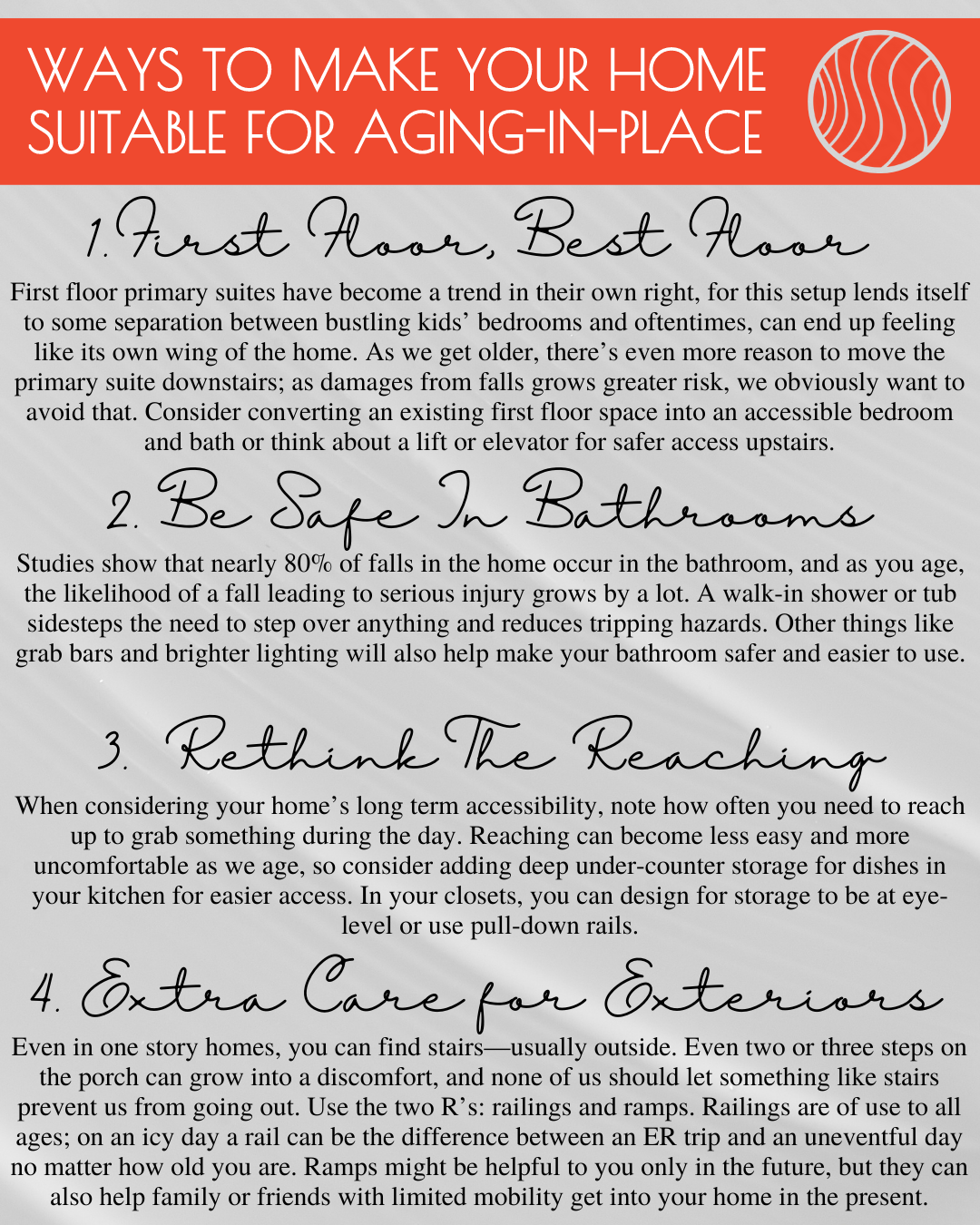
my current home is not conducive to someone with limited mobility. A temporary issue with a knee after surgery is only the tip of the iceberg; I am an architect, after all—I tend to coach my clients to think about how they might live in their homes in future years. The term aging-in-place gets thrown around often on the topic of retirement. Fundamentally, it means staying in one’s own home permanently, rather than moving into assisted living. Experts have made contrasting conclusions regarding aging-in-place; some say the benefit outweighs the risks, and some say the complete opposite. But when we look at what older folks have to say, the message couldn’t be clearer: Most of us want to stay in our own homes. Of those aged fifty and older, 77% want to remain in their homes long term, and according to the same AARP study, that number has not changed in over a decade. The biggest pitfall of aging-in-place comes down to the home itself; many of our homes don’t accommodate the changes in needs that come with age. As we get older, upstairs bedrooms, bathrooms without grab bars, and steep flights of stairs can cause discomfort and even danger.
a note from billdue diligence: don't design homes without itTHE DREADED MONEY PIT. HOW DO WE AVOID IT? THIS MONTH’S NOTE FROM BILL DISCUSSES THE IMPORTANCE OF QUIETING THE EXCITEMENT OF BUYING NEW PROPERTY, SO THAT YOU DON’T MISS THE RED FLAGS THAT COULD COST YOU LATER. When you come across a property that you absolutely love, it’s especially easy to feel anxious of potentially losing it to another buyer, so you pursue more aggressively than you really should. And we’ve all heard the horror stories: the couple who excitedly purchases their first house, only to find out months later that the foundation beams are rotting away; or the developer, with big ideas of an apartment complex, buys a property only to learn after closing that the site isn’t even zoned for that purpose. A property that bleeds you dry—financially, at least—strikes fear into all of us, yet it’s all too easy to think, “oh, that will never happen to me.”
The only way to steer clear of costly mistakes down the road is to think critically and do your due diligence before buying. When comparing which is worse, losing out on a property to another buyer or purchasing a property with significant underlying issues that need attention, I will always think the latter is far worse. Believe me, I know that it’s not fun to start imagining yourself in a home, only to have that property sell to someone else. But remember: there will always be another property. By applying these considerations, that next property will be far less likely to be a so-called “money pit”. a note from billfive reasons why a design+build firm could be right for you
style and functionality of your home, as well as the timeline and budget. And even before all of that, you need to choose which avenue to take to bring this project to fruition. The traditional avenue is to hire an architect, who does the design, and they hand it off to a contractor for the building phase. Another option is to hire a builder, who then contracts with an architect to design the project. Both options can have great outcomes and work well for many different types of clients; we ourselves often provide services through these avenues!
You may not be aware, however, that a third option is out there: an architect-led Design+Build firm. At Studio21 Architects, we offer the One Point Design+Build service. It combines the architectural and construction aspects into one unit within our firm, and through the entire process, the emphasis is on design. The potential for miscommunication and finger pointing common with the use of two separate firms diminishes, without sacrificing the quality of the work. Below, I’ve put together a few reasons why a Design+Build firm might be the right fit for you and your next project. |
Details
home about us portfolio services resources firm news contact |
RSS Feed